
India’s Largest Law Entrance Exam CLAT Set for December 6 — Here’s What’s Changing This Year
The Consortium of National Law Universities (NLUs) has announced the dates for the Common Law Admission Test (CLAT) 2027. CLAT will be held on Sunday, December 06, in offline mode. The entrance exam scores will be accepted by 27 NLUs, IIULER Goa, Delhi University, IIM Rohtak and over 60 private law schools across the country.
The online application for CLAT 2027 will open on August 03, at consortiumofnlus.ac.in. The last date for application submission is October 31, 2026.
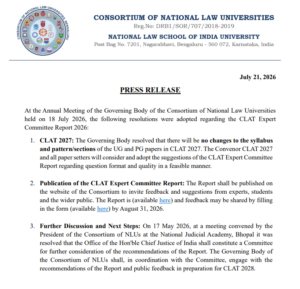
While the consortium was expected to conduct a revamped CLAT this year after constituting a reform committee, the consortium clarified recently that reforms will be applicable from the 2028 CLAT. This means the CLAT syllabus and pattern remain unchanged for the 2027 administration.
However, the consortium also said that Convenor CLAT 2027 and all paper setters will adopt the suggestions of the reform committee report regarding question format and quality in a feasible manner, indicating a major quality upgrade.
What qualitative changes can be expected?
Although the structure overhaul has been ruled out, students can expect significant qualitative changes in various sections of the CLAT syllabus. For example, questions can be recalibrated to test comprehension/application more than grammar and rote learning. This is likely to be reflected in English comprehension.
The report explicitly says the quantitative technique remains intact in the reformed version, but a variety of questions related to data interpretation should be asked. This doesn’t require a structural overhaul. So, quantitative techniques may test more skill sets than just limiting to advanced mathematical abilities this year.
Changes in legal and logical sections
The report flagged the overlapping nature of the logical and legal reasoning sections with each other and English. All these sections test comprehension in some ways. The logical and legal reasoning sections may have a clear distinction this year, despite both testing similar aptitude skills. No prior knowledge will be required in both these sections, except skills to apply principles and facts in different case situations and draw conclusions.
The overall quality of the test paper is also likely to change. Over the past few years, the CLAT has been criticised for being a test of reading speed rather than comprehension skills. Fast English reading is the basic prerequisite for succeeding in the current version of CLAT. The reform committee intends to change this perception by rewarding thoughtfulness and application over speed, which can be implemented from this year onwards without bringing structural changes to the pattern.